
Aliyya Hussain
The last few months have seen many Nigerian students calling out the government and their respective school authorities about the increase in school fees. No sooner had institutions gone on session break when students across the nation were welcomed back into a new session with new bills of fees that were predominately higher than the fees they were accustomed to paying.
The realities of increased school fees have left students disgruntled and fearful of the challenges they would face, especially in light of the Nigerian economy and the expensive nature of goods and commodities.
Perhaps a foreboding event might have been a result of the passing of a particular bill into law. President Bola Tinubu signed the Student Loan Act into law on June 12, 2023. While the Federal Ministry of Education stated, as reported by The Guardian Newspaper, “that the increment of school fees in government-owned universities was to cover the high cost of facilities by these institutions,” other educational bodies like the Academic Staff Union of Universities (ASUU) kicked against it, especially in light of its repercussions, which may be counterproductive.
Fast forward to school resumptions across the country, and amid the sheer resistance by citizens to the removal of fuel subsidies, federal universities across Nigeria began to increase what they described as discretionary fees. While many probed and argued that tuition wasn’t free in Nigeria anymore, Dele Alake, Special Adviser to the President on Special Duties, Communication, and Strategy, according to ChannelsTV, confirmed in a statement that all federal universities were still tuition-free.
According to The Guardian Nigeria, many institutions have increased their fees by 100 to 200 percent, which may force some indigent students out of school. Some of these institutions include the University of Lagos (UNILAG), the University of Uyo (UNIUYO), the Niger Delta University (NDU), the University of Maiduguri (UNIMAID), and the University of Benin (UNIBEN), to mention a few. Many of the institutions hinged on the lack of funding by the government and the rising inflation of the Nigerian economy.
However, this wasn’t readily accepted by Nigerian students. At the University of Lagos, a planned peaceful protest by the students has been scheduled to be held by September 2023 to show resistance to the fee hike. This always goes for the National Association of Nigerian Students (NANS), which condemned the inconsideration of students and cautioned the government to halt the fee hike immediately.
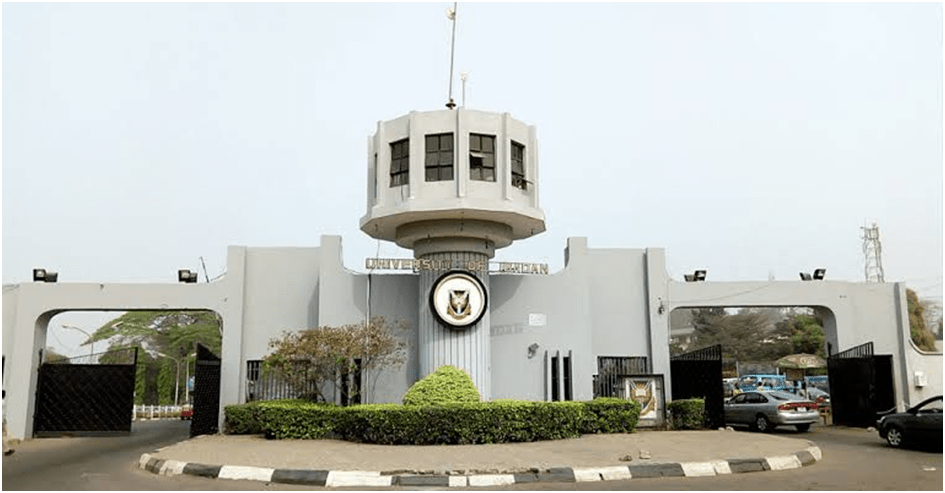
While each university struggles with the acceptance of the new fees with varying responses, it is a different ballgame at the University of Ibadan. In early August, there was some controversy over the fee increase because of the school management’s silence amid the fee hike among neighboring universities.
A few days after the school’s resumption, a document listing the proposed new fees for new and returning students was circulated in the school environment, leading many students into a state of turmoil and apprehension.
Although there was no official address confirming the authenticity of the fees, students had already resolved to accept their fate. In the document, it stated the addition of utility fees, but tuition was free. Laboratory and studio fees, department registration, accommodation, etc. were mostly increased.
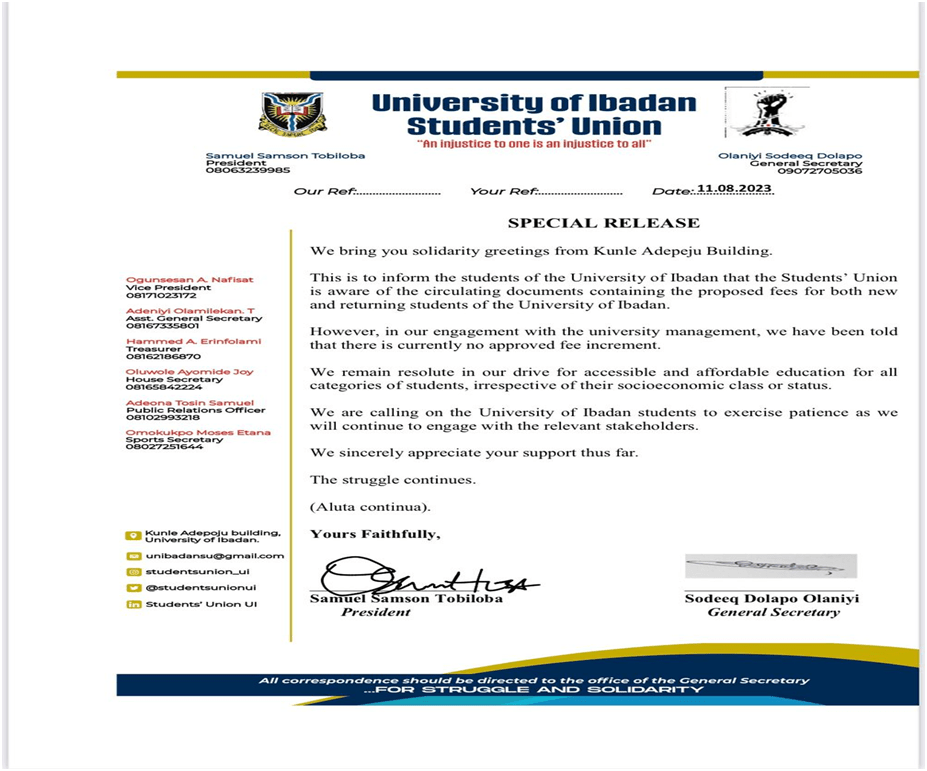
Then the payment of hostel accommodation commenced and confirmed the fears of returning students paying forty-five thousand naira (#45000) as opposed to the former thirty thousand naira (#30000), while new entry students paid sixty thousand naira (#60000). After addressing students on the proposed fee on August 11, 2023, the UI Students’ Union indulged the students to exercise patience and said that the school management had yet to finalize the fees.
On August 30, 2023, a new student portal link was circulated, which made it easier for students to see the approved fees. Surprisingly, the utility fee was also to be paid. However, Giwa Veronica, a 400-level student of Communication and Language Arts, was relieved the university was unlike her counterparts: “From what I have seen and heard, UI did not increase school fees. They added only the utility bill. Well, I don’t think anyone has been able to access the portal and make a payment. For now, let’s just watch and see how everything will play out.”
While some students were glad the fees were not as high as at the other schools, some disagreed with the new inclusion, stating they were also to pay some discretionary fees by their faculties and departments.
Favour Innocent, an Awoite, and a 300-level student of theater arts addressed the situation with disapproval. “Generally, I do not understand why they had to increase our school fees because the University of Ibadan is a federal school, meaning that the fees should be less than those of the states and private schools.”
While some students were glad it wasn’t up to the 100% increase, unlike UNILAG, Favour protested that there were students who struggled to feed themselves, and the little increase could cause strife in making ends meet for such students. “I know some might say the money added was little—10k. 20k, and what if it’s little? These amounts might look huge to some people. I mean, consider those who have to work to sponsor themselves to school. Does that mean extra work for them? Extra effort? Making it really hard for them to live in a country with an economic recession
Another Awoite, Seyi, a 400-level student of crop production and environmental biology, lamented about the whole situation by describing it as outrageous. She started with the federal universities being “the affordable option for children of the average and poor masses that dare to dream of furthering their studies.”
“But see what we have now. The fees are now even more than what some state universities pay. I know of a lot of people that have decided to defer their studies or just simply drop off at the university due to the increment. She further lamented.
She revealed she had more discretionary fees, such as laboratory, field trip, and others, to pay other than the total fees displayed on her portal. She also stated the school was not entirely at fault but rather due to the poor management of public institutions by the Nigerian government.
When asked how the increment may have caused some discomfort, Favour replied that she had no issue due to the long duration of fee payment. “Even though I really do not have any issue since the duration for the payment of the school fee is long enough for my parents to work with to raise it, I am grateful that my parents are the ones sponsoring my education. It’s not as if the school fee is to be paid instantly. If it were to be instant, then I’d have a problem.”
The University of Ibadan might have gotten a pat on the back for looking out for the payability of fees by its students, but students are nonetheless convinced that there have been subtle changes in fees at the school. While most students try to see the increment as an effect of the economic hardship in the country, many are bent on the school living up to its status as a public university.
 OBAFEMI AWOLOWO HALL PRESS
Leave a comment