
Sharon Adisa.
On May 12, 2022, the country got devastating news of a second-year student of the Shehu Shagari College of Education, Deborah Samuel Yakubu, who was mob-stoned and burned to death by some Muslim students of the same school for blasphemy of their religion.
Her alleged crime, in the eyes of the culprits for such gruesome murder, had been a request that students desist from posting religion-related posts on a class group that was strictly for academic purposes. The school was indefinitely shut down by Governor Aminu Tambuwal of Sokoto State, and two suspects were apprehended.
My initial reaction to the news of Deborah’s murder was to ask a pertinent question: why does religion have such a blinding effect on Nigerians?
This painful instance is one of many that have rigorously shaken the walls of the inter-religion peace treaty, for which the heads of each religious sect clamor every other year. The religious crisis Nigeria has been battling for decades with the terrorist sect Boko Haram is a testament to how far religious conflicts can go.
The matter of religion in Nigeria does not only center on national religious crises, i.e., on the macro level, but also holds reins at the micro-level in schools, neighborhoods, workplaces, and some other social factions in the nation where the problem of extreme religious ideas has always existed.
Over the years, the question of religion in Nigeria has been a controversial issue. With the recent happenings, it seems Nigerians are very sensitive and passionate when it comes to issues concerning beliefs or religion. With everyone standing their ground against any other contrary beliefs, the consequences of these stances lead up to pretty heavy conflicts.
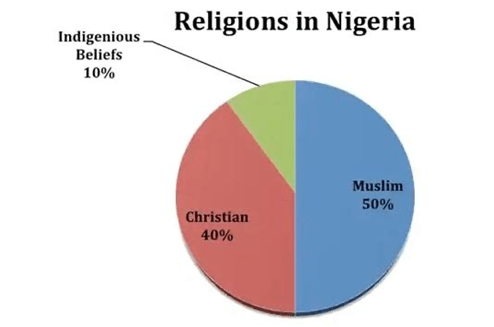
Nigeria, the sixth most populated country in the world and the giant of Africa, is home to over 200 million people whose religion gravitates towards Christianity, Islam, and traditional worship. Before independence, religion had been the foundation of the development and advancement of the country in different areas, from politics to education, science and technology, health care, and others. Given the strong hold religion has had in Nigeria, it’s no wonder it has turned into a contentious issue.
Nowadays, religious conflicts have become, unfortunately, something we see on the news constantly. Initially, the clashes were between Christianity and Islam, but now even the traditional worshippers have stepped onto the scene. For instance, on August 20, 2023, in Ilorin, traditional worshippers began to push for their holiday in the state as their line with other religious counterparts; however, the Muslim residents of the state opposed this movement, and thus a series of conflicts ensued.
The typical Nigerian attitude towards religion is extreme at the microlevel, where there are major religious differences and religious beliefs fueled by the close-minded nature of people.
Some days ago, I had a discussion with a friend who claimed her religion led her to believe that butterflies were agents of evil, and at the sight of one, she gets extremely frightened. This is just one example of erroneous beliefs that have limited people from thinking outside their religious beliefs.
Furthermore, religious beliefs have taught people to act differently than others. While it is completely OK to follow religious doctrines, they should never cause harm to another individual. Furthermore, some Nigerians credit religion for everything under the sun, claiming that their good fortune is due to spiritual powers or what are colloquially known as “village people.”
I’m not dismissing religion in Nigeria; I’m a firm believer, but it saddens me that most Nigerians become unreasonable when it comes to religion. We should be aware of religion’s limitations in certain areas and bear in mind that not everything should be examined through the lens of religion. Most of the time, reasoning and logic are all that are required.
According to an article published by the Guardian on February 22, 2023, a poll was conducted by SBM intelligence in conjunction with Enough is Enough (EiE) Nigeria to probe their voting criteria during the recent elections. In the result of this poll gathered from 11,534 Nigerians across the country, it was discovered that the majority of the respondents cited ethnicity and religion as their criteria for electing a political candidate.
Looking at this, it is evident that Nigerians are religiously sentimental when it comes to politics. This is uncalled for because our ethnic and religious sentiments are one of the reasons why the Nigerian political scene has been the way it has been. Political candidates instead drive towards appeasing Nigerians’ religious sentiments rather than ensuring good governance, as it has also been considered another major issue in the country.
The Muslim-Muslim ticket matter that was circulating in the news during the 2023 presidential elections is also evidence of religion in politics. Does religion have anything to do with good governance, or is it a matter of competence?
It is really concerning that religion has become so entrenched in our culture that we turn to church houses, mosques, and shrines whenever a minor annoyance arises rather than standing up and accepting responsibility and accountability for our acts.
Again, I am not dismissing any religion, but the rate at which Nigerians have gotten so blinded by religion is troubling, to the point that it appears that we can’t clearly think through things and handle conflicts without involving religion.
It may be time to get up and analyze how we might improve the nation by removing the blindfold of religious fanaticism that has been fastened to our eyes and maintaining national unity.
 OBAFEMI AWOLOWO HALL PRESS
I want to acutely support the opinion of Sharon Adisa. We’ve actually been really religiously blinded. It’s very saddening how people no longer show love to others from other religion love just because others don’t believe in what they believe in. No matter what, let love lead.
I’m a Christian, and there’s no where in the word of God that tells us to hate on others because they don’t believe in Christ, but Christ clearly stated that he has come because of the unbelievers and he as well wants us to show love to every single person, whether from same religion or not. Our love should not be segregated to those who share our belief, but to all and sundry. I strongly believe this is what other religion might also entail. We Nigerians are the one making it looks how it isn’t supposed to be.
Showing love is the best way to show that you truly love God. Please, let’s make love lead! Desist from religious segregation and discrimination, as this is the only way to foster peace in our beloved country, Nigeria, and even the world at large.
LikeLiked by 1 person