

By Oluwatosin Adeoye
Ever since Nigeria gained independence on October 1st, 1960, the country has had its fair share of political administrations, elections, civil war, disparities amongst those wielding power, and election tribunals. The tussle for power transcends elections and manifests itself as a body battle of law, evidence, bureaucracy, and everything in between. One may say that where there is no law, there should be no sin, and all things are allowed. However, if there is a law, justice ought to be served where injustice is perceived to be done.
According to Collins Dictionary, a petition is a formal request made to a court of law for some legal action to be taken, while an election petition is defined by Wikipedia as the procedure for challenging the result of a parliamentary election.
According to the Electoral Act 2022, in an article by Law Padi, the election petition process includes gathering information, filing the petition, a pre-hearing session, hearing the petition, potential outcomes, and an appeal.
At the instance of challenging the result of an election process, there are a lot of personalities largely involved, ranging from the supposed victorious candidate to the “now ruling party” to the electoral body that organized the election to the citizen who voted during the election and other important personalities involved in the entire electioneering process.
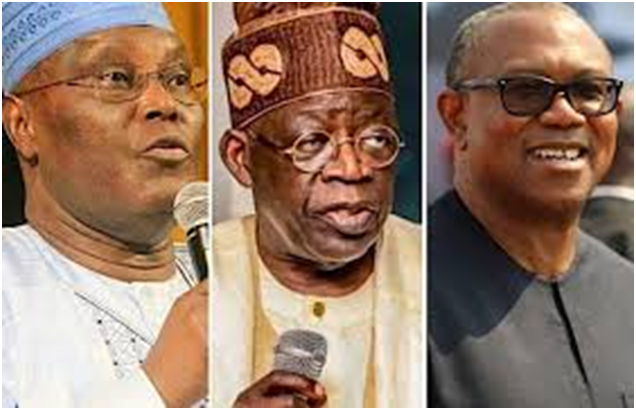
THE TUG OF WAR BETWEEN OBI, TINUBU, AND ATIKU
Peter Obi, the presidential candidate of the Labour Party, filed his petition with the election tribunal on Tuesday, March 21, 2023, 22 days after the hotly contested presidential poll was conducted. In his petition, Obi stated the grounds for the appeal and the determinations he wants the court to make, which included the determination of the qualification or otherwise of the presidential and vice presidential candidates of the All Progressives Congress (APC), the declaration of wasted votes, and the declaration of the winner.
Likewise, Atiku Abubakar, the presidential candidate for the People Democratic Party, filed an election petition for the withdrawal of the Certificate of Return that was issued to Tinubu by the Independent National Electoral Commission, INEC. He stated that the announcement declaring Tinubu as the presidential election winner was “invalid by reason of non-compliance with the provisions of the Electoral Act, 2022.” He prayed for the court to declare him the winner of the presidential election, having obtained the second-highest number of valid votes cast.
THE PLACE OF ETHICS AND JUSTICE
According to an article published by The Punch Newspaper, the court stated that though the petition contained serious allegations that bordered on violence, non-voting, suppression of votes, fictitious entry of election results, and corrupt practices, Obi and his party, however, failed to give particulars of specific polling units where the incidents took place.
The court, in its preliminary ruling that was delivered by Justice Abba Mohammed, held that Obi and the LP did not, by way of credible evidence, establish their allegation that the election that was held on February 25 was characterized by manifest corrupt practices.
It held that though the petitioners alleged that the election was marred by irregularities, they, however, failed to give specific details of where the alleged infractions took place.
The court noted that whereas Obi and the LP insisted that the election was rigged in 18, 088 polling units across the federation, they were unable to state the locations of the said polling units.
It further held that Obi’s allegation that fictitious results were recorded for President Tinubu and the APC by the Independent National Electoral Commission, INEC, was not proved.
Looking at the above excerpts, the judgment should border on convicting the alleged party and possibly rendering the last general election null and void, but shockingly, it did not go that way. Emotions do not rule in court. Facts, figures, evidence, and the constitution take the lead.
The concept of justice, although universal, is in fact relative, and although many avid Peter Obi supporters perceived the verdict of the court to be wrong, the realities of the election tribunal showed that one does not get “presumed justice” at the court of law in Nigeria solely based on abstract notions and convincing speeches.
THE IRONY OF THE CASE
While favorable to Tinubu, the tribunal’s ruling was unlikely to generate any particular euphoria or momentum for the president after an election marked by a record low turnout of 29%. In a nation of more than 200 million people, of whom 87 million were registered to vote, Tinubu garnered just 8.79 million votes, the fewest of any president since the return to democracy, limiting the goodwill towards him.
In lieu of the announcement of the judgment, Obi can appeal to the country’s Supreme Court to strike down the tribunal’s ruling. Any appeal must be concluded within 60 days of the date of the tribunal judgment. Hence, the countdown began on the date of the judgment.
On the next point of action for the party, the legal adviser of Peter Obi disclosed that the apex court will be the final arbiter. “There are some filings that are unacceptable to us. So we need to see what the apex court has to say about this. We have to address this, not only for today but for the sake of our jurisprudence. We want to see what the judges at the Supreme Court will say about all these. It is so important to do this for the sake of tomorrow.”
It is imperative at this point to note that when the presidential election petition proceedings began in March 2023, Nigeria’s Supreme Court comprised 13 justices. The court had received a bumper injection of seven new justices in November 2020, after the conclusion of the disputes arising from the presidential election of the previous year. That was the last set of appointments to the Supreme Court.
In a democratic system of government, the judicial arm of the court ought to be the final arbiter in cases of perceived irregularities or injustice from the other two arms. When the league of justice at the nation’s Supreme Court is less than 20, should it be a thing of concern in relation to the strength of justice in the nation?
A GLIMPSE OF HOPE OR A WASTE OF TIME
Election petitions in Nigeria, especially presidential election petitions, more often than not, turn out to be a process of futility, as after various long court sittings, lengthy documents, and piles of evidence, the results of the tribunal remain in favor of the person already elected into office.
The reason behind this can be attributed to multiple reasons that revolve around godfatherism, corruption, bureaucracy, and the political climate in Nigeria. It’s for this reason that the outcome of the election tribunal did not phase or shock Nigerians. In fact, if the outcome was in favor of Peter Obi, it would have become a momentous time in Nigeria, one that would shake the very foundation of politics and justice in Nigeria.
However, not all election petitions have been hopeless, as seen in the case of the Zamfara Tribunals. In a statement released by the governor’s spokesperson, Sulaiman Idris, on Monday in Gusau, it was emphasized that the tribunal’s verdict reflects the resounding choice made by the people. “A while ago, Dauda Lawal was affirmed as the winner of the March 18, 2023, governorship election at the Zamfara Governorship Election Petitions Tribunal sitting in Sokoto. The judgment was not surprising but rather an affirmation of the collective decision made by the unwavering people of Zamfara,” the statement partly read.
Whatever the case might be, Nigerians would continue to wait with bated breaths, dangling on the ropes of hope and futility. At the end of the day, one thing is certain: Nigerians will surely adapt to whatever the eventual outcome might be.
 OBAFEMI AWOLOWO HALL PRESS
Leave a comment