

By Kolade S. Olakiitan
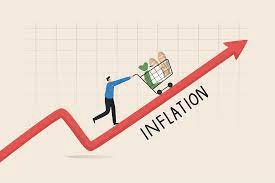
Inflation is one of the most familiar words you’ll come across in economics. Economists use the term inflation to describe an increase in the general price level of goods and services in an economy within a given period of time, usually a year. The inflation period is characterized by an increased money supply, higher prices, and a decline in the purchasing power of money. This means that a unit of currency will cost less than it did a year ago because, with higher prices, people have less money to pay for goods and services, leading to a drop in the standard of living.
Simply put, inflation describes a “plenty of money, few goods to purchase” situation. There are two main types of inflation: Demand-pull and cost-push inflation. When there’s a rising production cost, the prices of basic commodities will increase as well. Similarly, an increase in aggregate demand in the economy will push prices upward, thereby causing inflation.
The high rate of inflation is one of the economic problems facing Nigeria, coupled with the effects of the withdrawal of subsidies by the government. It is the duty of the Central Bank (CBN) to handle issues pertaining to inflation by applying the appropriate measures. There has been a persistent rise in the inflationary rates in the country; as of June 2023, the inflationary rate in Nigeria was 22.79%; it climbed up to 25.8% in August and has still not dropped.
All aspects and sectors of the economy are touched by inflation, and every individual is affected, including university students. Fixed-income earners such as salary earners and pensioners suffer a lot because prices increase while income remains the same. The increasing cost of living without a corresponding increase in their income will force them to adjust their spending patterns, resulting in a decline in their standards of living.
Inflation is a global economic issue that every country aims to tackle, but not completely, because a little bit of inflation is an indication of a healthy economy, an increase in the GDP, and buzzing economic activities.
Almost all Nigerians know what inflation is, not because they’ve read about it or have been taught about it, but because the prices of goods increase with every new visit to the market. The immediate rise in the prices of staple foods such as rice, beans, yams, and cassava, among others, is what most Nigerians use to gauge the extent of the effect of inflation on their spending. The kind of inflation in Nigeria is largely cost-push because, as the cost of production increases, producers shift the cost burden more to the final consumers.
College students are definitely not immune to the effects of inflation, as the prices of basic necessities such as food, housing, and transportation are on the rise. Inflation raises the costs of education too because the university has to keep up with the rise in prices as well. The recent wave of increases in school fees at federal universities is a testament to this. A lot of students have had to take up part-time jobs, learn a new money-making skill, cut back on the amount of food they eat, and trek most of the time to reduce transportation costs.
The high inflation in Nigeria can be linked to reduced production of agricultural products. Nigeria has been dealing with the problem of insecurity, especially in the northern parts of the country, where most of the cereal crops are grown. The incessant killings in the North have halted the production of food. The killing of farmers on their farms and kidnappings on the road during the transportation of food have contributed to this issue. Also, the economic policies of the government, such as increasing the money supply in the economy, can stimulate inflation. Inflation is basically too much money chasing fewer goods. When there’s too much money, sellers want to make more profits by reducing the quantity available for sale and increasing the prices of their goods.
An expectation of a rise in price can cause inflation. Information about a future change in price can cause people to demand more of a good or service. For example, an expectation of a rise in the price of palm oil can make a consumer buy more than his usual ten gallons; let’s assume he buys fifteen. An increase in demand will drive prices up. Similarly, when producers foresee an increase in the price of their goods, they tend to hoard the available ones in order to sell them at a higher price. Let’s examine the common phenomenon of fuel prices in Nigeria. As soon as information regarding a likely scarcity of fuel begins to go around, we find out that filling stations begin to lock up not because they don’t have fuel but because they want to sell at a higher price, hence causing artificial scarcity.
A devaluation of currency is a reduction in the value of a country’s currency in terms of a foreign currency. It makes a country’s money cheaper relative to other foreign currencies. Devaluation encourages exportation and makes importation more expensive. For a country like Nigeria that is largely import-dependent, devaluation has worsened the problem of inflation. Somewhere in our subconscious minds, we believe that imported goods are better than domestically produced goods, thereby contributing to the high importation of goods into the country.
It is the duty of the government, through the Central Bank, to tackle the issue of high inflation. There are various ways through which this can be done; an increase in interest rates is one of them. To mop up the excess money in circulation, the CBN can increase the interest rates on loans and stimulate savings. Closely monitoring both the formal and informal sectors so that policies are well implemented and carried out. The government should tackle the problem of insecurity, as it hinders food production. Large-scale food production should also be encouraged in rural areas through the provision of sophisticated machines and training. The government should find an alternative solution for the epileptic power supply that hampers the growth and development of small and medium-scale enterprises (SMSE).
As Nigerians, we have a part to play in this as well. We should get more productive, encourage a working culture among teenagers and youths, and not only focus on graduate employment. This will help to cushion the effects of inflation on the most vulnerable people in society. Nigeria still has a long way to go in the fight against inflation. An increase in food production and productivity is generally a good starting point.
 OBAFEMI AWOLOWO HALL PRESS
Excellent Analysis!
Your points about Nigeria’s economic challenges are spot on. Let’s work together to solve issues like inflation and boost productivity for a brighter future.
LikeLiked by 1 person