

By Aliyya Hussain
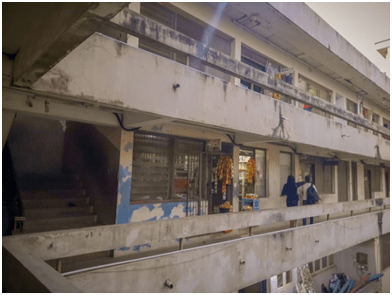
If an Awoite were to carefully explore nearly every floor of the Obafemi Awolowo Hall of Residence, they would probably come across a plethora of stores with consumer goods, spanning from everyday necessities to various vocational businesses like hairdressing, tailoring, and clothing sales, among others. This abundance of amenities raises the question of whether venturing outside the hall for necessities is even necessary, given that everything one might need is readily available within its confines.
Notably, all these vendors operating within the hall are officially registered, and it is a rarity to come across a student among them. For some, their shops within Awo Hall serve as their primary sources of income, while others are involved in different prosperous enterprises.
But what becomes of these vendors during times when Awoites have completed their academic sessions and nearly everyone vacates the hostel? Or when the Academic Staff Union of Universities (ASUU) announces yet another indefinite industrial action? Do they shut down their shops and seek alternative opportunities elsewhere? How do they cope with the disruption to their daily livelihood, and what strategies do they employ to bounce back when schools eventually resume?
Perhaps we can find an explanation by looking at the situation during the COVID-19 pandemic and a year-long strike. When the university reopened for physical classes in 2021, students returned to the campus and their respective halls of residence. The condition of the shops was surprising; some had vacated their hall, and those who returned had very few items in their shops. Even someone with minimal knowledge could sense that something had gone awry during those times. To better understand the challenges faced by these vendors in those trying times, this reporter took her time to ask a diverse group of vendors across the hostel about their experiences during school breaks and the usual prolonged industrial strikes, and these vendors had quite a lot to say about it.
MR SOLOMON, popularly known as Bro Solo (Shoemaker)
It’s not easy o. At the moment, I’m working on a store elsewhere for times like that. The ASUU strike is a long story, and then everybody start to dey hustle. I do the same job I do here outside during the strike and sometimes I do another work to survive. I needed businesses during the strike. I had to meet up with one of my friends to link me up with a job and that time, the job I did, people didn’t know I could do that job sef. But sometimes I get jobs from customers from Awo during the strike and also outside the hostel. I get jobs from different people, even Lagos.
AUNTY D, also known as Mummy Geradynn (Provision store owner)
I come around to Awo and pack my things to take home and eat. I’m in my husband’s house and everything we need at home, I come to the shop to pack before it expires. I have no side job, I thank God my husband had a stable job.
MRS LOLA (Hairdresser)
I have experienced a lot of things, you know those times, you have to be at home. During normal breaks, I stay at home. But for ASUU STRIKES, I had to go and look for something else to do. I can’t just stay indoors, doing nothing because I have to take care of my children and I have to keep myself busy so I used to look for something else to do instead of staying at home, doing nothing. It has affected me and also blessed me because I opened my eyes to another business which is even fetching me more than the one I’m getting in Awo. So I thank God that at least, I didn’t stay indoors, I tried to look for things to do, so that is it.
AUNTY LARA (Hairdresser)
Business is always slow o, during breaks, and ASUU STRIKES too. Everyone usually finds something else to do outside. I don’t have a shop elsewhere. For me now, I follow caterers to events to find another source of income because there’s no business at all in Awo during those times.
MRS SOGA also known as Mummy Fikayo (Provision store owner)
We too need rest. To work is not easy, coming to Awo Hall, from maybe 8 am to 9 pm in the night. So during the strike, we go on a rest but we also save for rainy periods. I don’t have a store elsewhere but other side hustles that do not require much energy like this one (points at her store). We manage the little income we have so that we won’t get bankrupt when they resume so that we won’t be looking for money up and down. But majorly, I use the period to rest. During the last break, the postgraduates were around and some of them are my friends, so I just dropped my key for them so that they can chat one another up when they need something. And it’s not everyone that can do that, it’s based on trust. And the income is not very impressive as to when undergraduates are around. Maybe in a week or two weeks, you will hardly see #10,000 and that #10,000, all of it is not your profit. The ASUU strike last year was not funny. Most of us vendors went bankrupt. Thank God I had little savings to bounce back. Sometimes I will come and pick something and check the expiry date. If it’s near, take it home, eat, come back again and check. It’s not easy at all but we pray such strike should not happen again. It’s not that easy to bounce back. We went through a lot that period of time but what can we do? We know that when students are back, we have it all again. Every business has its own challenges, for us, our major challenge is ASUU strikes.
MRS OLANIRAN (Provision store owner)
Sometimes, I don’t come to shop again because students won’t be around. So what’s the point of coming to the shop? So it ways affect sales and it always tells on me. Other vendors complain a lot and some don’t have any other means but some do have other means, maybe they are government workers and they just have a store, so during breaks, it doesn’t really affect them but because of the situation in this country now, they can’t just depend on a salary, you just have to look for other means of income. So it really affects me. ASUU STRIKES takes a lot of lengthy days, weeks, months and it really affects me, because at that time, students will be at home, demanding many things and this is another source of income for me, I have to take care of my children and ASUU is on strike, they will be at home and some of them, that are in other universities will come home, eating on one person’s salary. I have other means of income but I really pity some people that don’t have any other means.
One of the Hall sanitation workers, popularly known as Mummy Oba also shared her perspective. “When we are on strike, just like two people come in a week, another two come the following week. For the time of Corona strike, we did it like that. I do not have any side hustle but because of transport fare and because there are no students around, we stick to not coming often. We just check and do some things we can and go back home.” She said.
The conversations with the vendors revealed a treasure trove of valuable experiences and viewpoints. However, a prominently recurring theme in their stories was the struggle each vendor encounters during school breaks and prolonged strikes. This struggle encompasses dealing with products nearing expiration, a reduced customer base, and the pursuit of alternative sources of income until school fully resumes.
This aspect of being a vendor within the hall, aside from sales challenges and the high cost of products, stands out as one of the most distressing. It’s ironic that while students celebrate the end of a semester with smiles, vendors are already pondering their next steps to sustain their livelihoods. Nevertheless, as one of the vendors wisely noted, every business has its share of challenges. It is our sincere hope that these vendors continue to rebound resiliently after the end of each academic session and the unprecedented breaks in the university calendar.
 OBAFEMI AWOLOWO HALL PRESS
Leave a comment