

By Aliyya Hussain
On the 3rd of January, 2024, the University sprang back to life as academic activities recommenced, signaling the start of a new semester for students across different faculties. While many eagerly anticipate the plethora of activities awaiting them in the coming months, some students find themselves ruminating over their past performance. With first-semester examinations becoming a thing of the past in 2023, thoughts of their course grades linger in the minds of many, leaving them in a state of constant worry. Some students sought solace in the hope of receiving favorable results, while others chose to divert their attention elsewhere, opting to engage in different activities rather than dwell on their grades.
Awo Hall in 2024 is brimming with energy as its occupants eagerly anticipate yet another semester within its walls. While the atmosphere appears to be typical of the beginning of a new academic term, a glimpse into the long rooms on Mummy Dee’s floor during late evenings could leave one questioning whether the semester has just begun. However, this revelation should not come as a surprise considering the numerous factors contributing to such an observation. A renewed sense of determination engulfs the University, as students embrace the opportunity for a fresh start in the new semester.
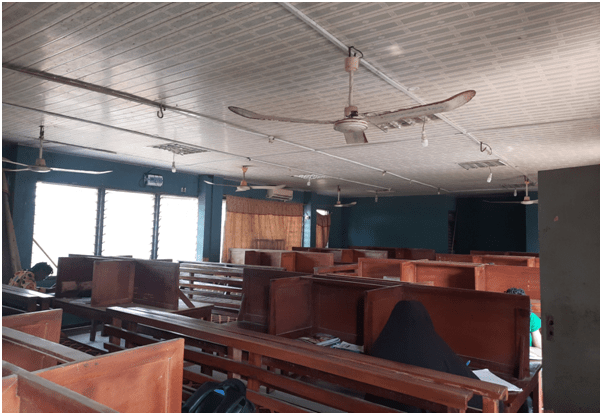
As this reporter observed, they hasten to the reading rooms, seeking an environment that fosters focus, productivity, and the potential for academic growth. For many, this is seen as a chance to redeem their academic standing. While they await for the results from the previous semester, their drive and determination to improve lies primarily in the forthcoming semester. Technically, for students, the beginning of each academic year is a time to familiarize themselves with courses, schedules, and other aspects of university life. However, in the second semester, there is a prevailing sense of equilibrium, prompting many students to seize the opportunity to rectify and enhance their academic performance.
The acknowledgement of this phenomenon brings forth a distinct irony, as the second semester is often characterized by a multitude of events. One could say that the second semester wears two hats, offering a chance for academic redemption while also inundating students with a plethora of activities that may hinder their ability to find a balance. SmartBukites have pointed out that social events, such as school, departmental, hall, and faculty weeks, along with other interesting activities, along a reduced course load, contribute to what is commonly known as the “second-semester syndrome,” which can potentially impact one’s academic performance.
It seems that students have become aware of the bloom and bustle that accompanies the second semester and have made a conscious effort to maintain equilibrium this time around. The sight of students occupying reading rooms amidst the stemming excitement of various events taking place throughout the school can only be attributed to their determination to seize another opportunity to elevate their grades or reignite their passion for learning.
During the early days of the semester, this reporter came across students who were already studying their books diligently. When questioned about why she had her books in front of her, Sheyi Olaniyan, a fourth-year student of German, expressed her eagerness to stay ahead and make the most of the semester.
“I read early in second semester because I’m aware that there are activities lined up in second semester so if I don’t start early, I’ll be joking with myself and eventually in the course of the semester, I would regret not starting early. So I will stay early so that by the time the event starts rolling in, I’m not lagging behind in things I need to read. I want to catch up early so that when the events come I can actively participate and I’m still on point in my academics.”
Similarly, Agboluaje Damilola, a final-year student, expressed that she tends to begin reading early to have a wonderful time every second semester.
“I read early into the semester because I want to have time to enjoy the events that come with the second semester.”
Moreover, the notion of reading early in the semester appears to dissent as Oluwajenrola Osho, a 300l student expressed her belief in balancing school work and participation in events during second semesters.
“Honestly, I don’t care about reading early but I respect the people that do that. I believe in balancing both schoolwork and partying. And it’s very ironic that the semester is divided between people trying to make up for the first semester and also trying to have fun. Many will be able to balance it perfectly and others won’t.”
Contrary to Oluwajenrola’s opinion, Inioluwa Adeye, a 300l student disagreed with the idea of balance and supported the idea of early reading if it is one’s priority to get excellent grades.
“In reality, I don’t think the word balance is actually true because you can’t balance everything, you can’t do 50/50, you just have to prioritise well. Something would definitely have to suffer. So when you’re talking about academics, social life and everything, you just have to make the decision of which one pays the most, that corners your own future plans. Itself not everyone that wants first class or second class upper. Someone just wants a 2.2 and attends social events to build up something that’s related to her future plan. It just depends on individual priorities and their own plans for the future. If you are someone coming to UI to get a first-class, you will definitely get it and your social life will definitely suffer, there’s no 50/50”
Subsequently, Rachel Idowu, a 200l of Communication and Language Arts believes that each individual has their own preferences and what works best for them i.e if students who prefer early reading choose to start the second semester at full speed, it is because it aligns with their personal preferences.
“I’m a strong believer that there’s no straight way to everything. Everybody does what works for them. I believe in putting one’s best in both semesters, how tremendous it might be getting your foot in first semester. With the whole early reading, our faculties and departments are different and how we grasp things differs, some people don’t mind waiting till exam period to catch up because they know they will catch up and some know that they are slow learners, they won’t want to wait till the time. So I feel like everyone should do what works for them. If you want to start early, do that, if you want to read at night and go to events during the day, it’s your choice, whichever works perfectly for you. But then I also believe that as much as you are in school to read, you also have to have a social life because of networking in the real world. You just have to balance it out, read a little, play a little as much as you are comfortable with it.”
As gathered in this article, the contrasting perspectives of students regarding the importance of early reading and maintaining a balance between academics and social events in the second semester are highly based on motivations behind students’ choices, personal priorities and individual goals. Some students prioritize early reading to excel academically and take advantage of the numerous events that occur during the semester. Others believe in finding a balance between academics and social life, recognizing the value of networking and personal growth outside of the classroom.
This potentially concludes that there is no one-size-fits-all approach to navigating the second semester. Each student must make choices that align with their academic aspirations and plans.
 OBAFEMI AWOLOWO HALL PRESS
Leave a comment