In 2018, Ahmad Salkida, a Nigerian journalist, felt the backlash of the Nigerian Army for telling the truth. He was known for his bold reporting on Boko Haram. He shared what many were afraid to say. Expectedly, his work upset those in power. In 2013, he went into self-exile. When he returned to Nigeria in 2016, he was arrested at the Nnamdi Azikiwe International Airport. Salkida represented the increasing danger journalists face for simply doing their jobs.
Every year, World Press Freedom Day is observed on May 3. It is marked by UNESCO and recognised globally as a time to reflect on the state of press freedom, pay tribute to journalists who have lost their lives, and reaffirm the importance of a free and independent media.
Press freedom is not just two mere words. It forms the backbone of true democracy, which states that the press holds those in power accountable and provides accurate information to the citizens. Now, imagine a bird soaring high in the sky, singing its sweet melody for all to hear. On the other hand, imagine a bird locked in a cage–its song silenced, and its wings clipped. The first is an apt representation of press freedom as enshrined in the constitution. In contrast, the caged bird represents the suppression of press freedom.
The Nigerian Constitution supports press freedom. The 1999 Constitution of the Federal Republic of Nigeria gives this hope. Section 22 states, “The press, radio, television and other agencies of the mass media shall at all times be free to uphold the fundamental objectives contained in this Chapter and uphold the responsibility and accountability of the Government to the people.” Section 39 guarantees the right to freedom of expression, including the freedom to hold opinions and to receive and impart information.
But in reality, these rights have become an “aroko”—a coded message of Greek gift. You give with one hand, you hijack with the other. Journalists like Tega Oghenedoro (Fejiro Oliver), Agba Jalingo, and Jones Abiri have been arrested or harassed for exposing the truth. Jalingo was arrested and discharged after 30-month trial in 2019 after demanding accountability of public funds from the Rivers state governor. Jones Abiri was arrested in 2016 and held for two years without charge, just for publishing a report that upset powerful people.
Behind the façade of press freedom are the threats that “shush” to death. Some journalists have lost their lives. Enenche Akogwu, a Channels TV reporter, was killed by Boko Haram in 2012 while on assignment in northern Nigeria. Alex Ogbu died in 2020 while covering a protest and reporting on police abuse.
This is not just happening in Nigeria. Around the world, journalists are being targeted. In 2018, Jamal Khashoggi, a Saudi journalist, was murdered inside the Saudi consulate in Istanbul. In Myanmar, reporters Wa Lone and Kyaw Soe Oo were jailed for reporting on violence against the Rohingya people. In Turkey, over 150 journalists are behind bars, many for simply doing their jobs.
All of these examples show a worrying trend: when governments do not want the truth to be known, they go after the press. But attacking journalists does not protect a country—it weakens it. When the press is silenced, people lose their right to know the truth truly or truthfully.
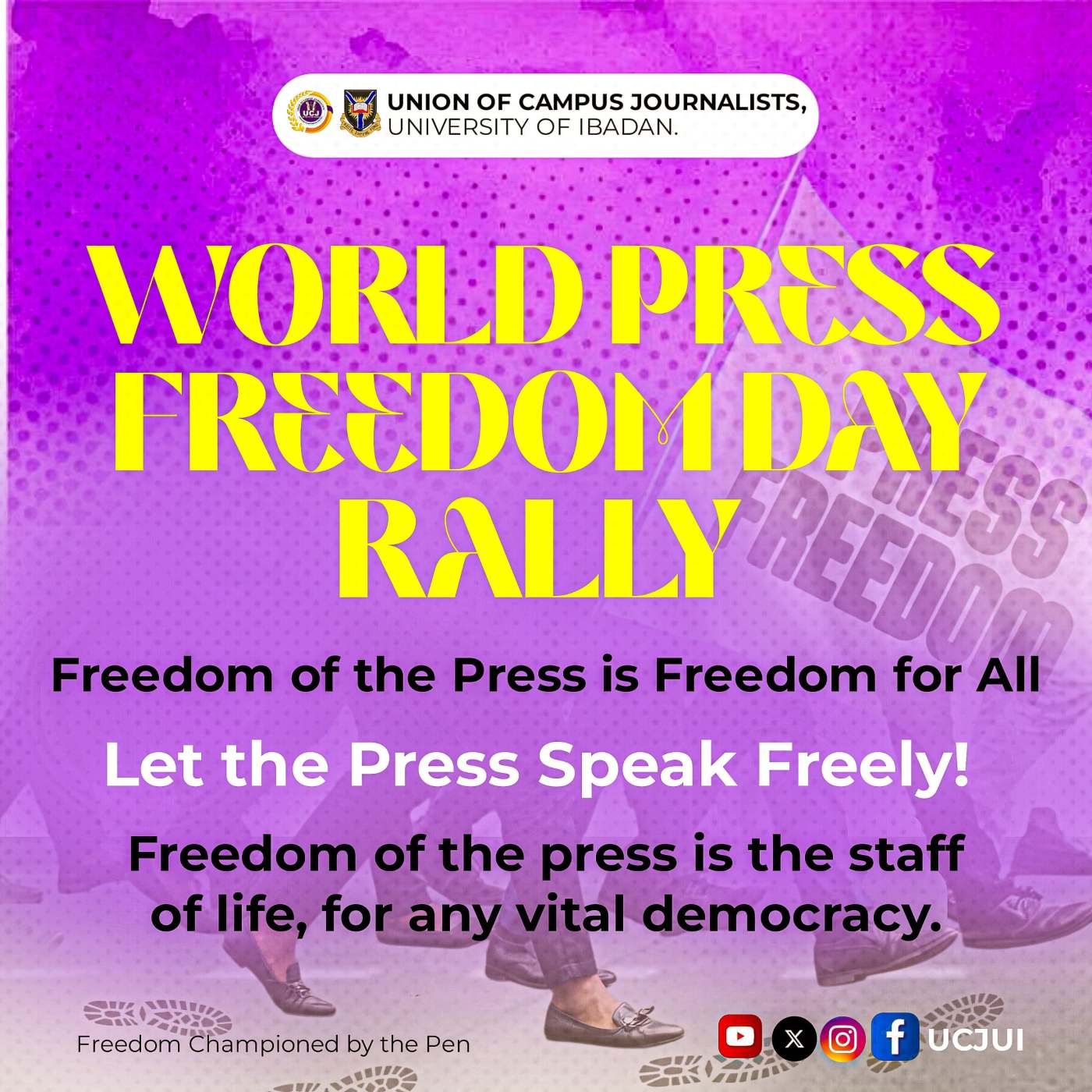
In this view, the Union of Campus Journalists, UCJ UI, commemorated press freedom on March 2nd, 2025. It brought campus journalists together to sensitise people about the press. The press is not the enemy. It is a noble profession regal in honesty and accuracy.
On this World Press Freedom Day, we must remember the journalists who have been arrested, attacked, or killed for doing their jobs. We must protect those who are still reporting the truth. And we must all stand together to defend press freedom.
World Press Freedom: Why the Freedom Matters
 OBAFEMI AWOLOWO HALL PRESS
Leave a comment