
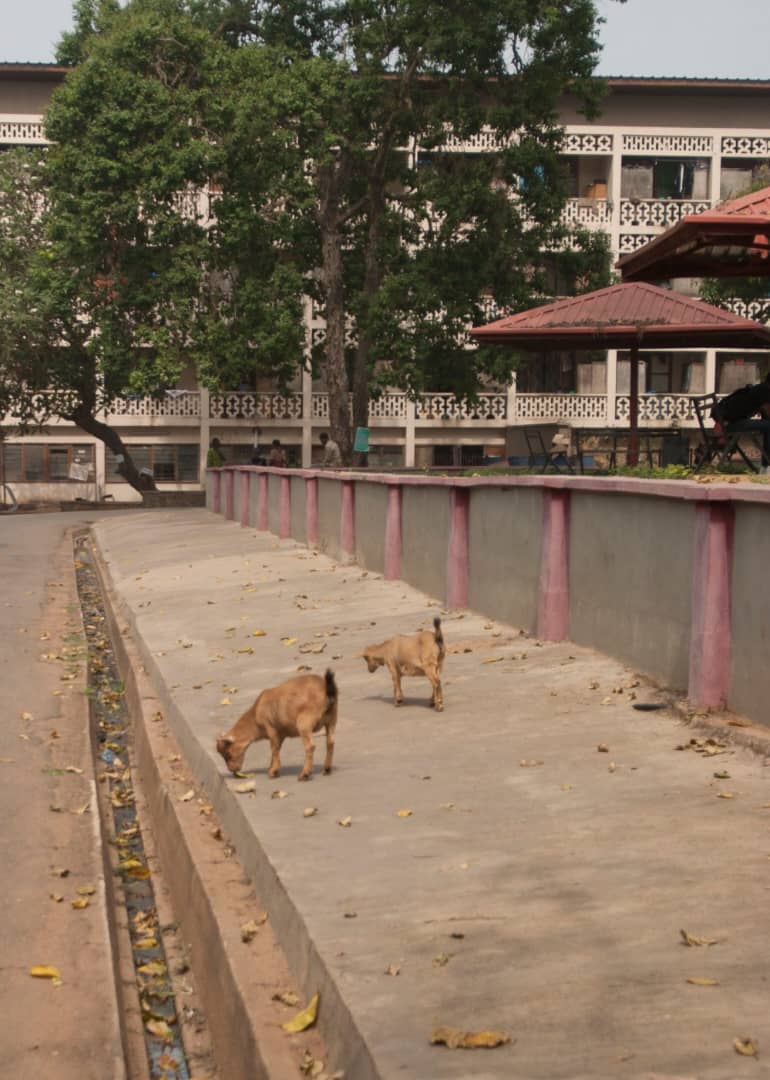
The University of Ibadan is a bustling world unto itself, a microcosm of human ambition and activity. Its walkways are rivers of students, its lecture halls are filled with the clamour of learning, and its buildings stand as silent monuments to knowledge. But woven into this intricate tapestry of human life is another less-noticed population: the unofficial residents. These are the campus dogs, the herds of goats, and the occasional solitary cat, who navigate the same paths and occupy the same spaces with a quiet grace. They are not pets, nor are they truly strays. They simply are. They exist in a liminal space, an essential part of the campus’s rhythm, a subtle reminder that “All of nature is a vast and intricate web, and we are but one strand.”
The dogs of UI are perhaps the most visible of these unofficial residents. You’ll find them almost everywhere, but they are a particularly common sight in places like Abadina, Barth Road, and the residential areas of UI and Idia village. They are curled up in a patch of sun outside a faculty building, cautiously approaching students near a cafeteria, or sleeping soundly in the shade of a parked car, seemingly oblivious to the bustling world around them. These are not domesticated animals, yet they possess a quiet intelligence, an understanding of the unspoken rules of co-existence. They know which students might offer a scrap of food and which ones to keep a respectful distance from. There is a sense of shared, weary trust between them and the student body. The animals offer no demands, only a silent presence, and the students, in turn, offer them a safe space. This fleeting connection asks for nothing but gives a small dose of simple comfort, a reminder that “There is no exquisite beauty without some strangeness in the proportion.”
Then there are the goats. They are the pastoral element in an academic setting, a charmingly out-of-place sight. You might be walking to a lecture when you see a small herd peacefully grazing on a lawn near the halls of residence, their presence a curious, almost comical sight. They move with an unhurried grace, completely unfazed by the rush of students around them. Their life is simple: find a patch of grass, chew contentedly, and move on. Their existence provides a striking contrast to the relentless pace of academic life. While a student’s mind is a whirlwind of deadlines, assignments, and future plans, the goats simply exist in the present moment. Their peaceful presence serves as an unintentional meditation, a quiet moment of clarity in the face of academic chaos. They are a living representation of a simpler, more organic rhythm, a subtle commentary on the saying, “The grass is always greener on the other side, but it’s still grass.”
What makes these animals so integral to the UI experience is not just their physical presence but what they represent. They are a mirror to the students’ own journeys. Just like them, these animals have to adapt and survive. They find their place in a world that wasn’t built for them, carving out their own niches and finding their own sources of comfort and safety. They teach, without a word, a profound lesson in resilience and perseverance. The dogs find shelter from the rain under an awning, and the goats find sustenance in an urban landscape. They are a testament to the idea that a living thing, no matter how small, will find a way to thrive if given the chance.
For many students, the campus animals offer a welcome break from the relentless pressure of university life. They are a source of simple joy, a momentary distraction that allows the mind to rest. A student might be pondering a difficult theory or struggling with a research paper, and the sight of a dog stretching lazily in the sun or a goat nibbling on a shrub provides a brief, but necessary, mental reprieve. These animals are a constant, unchanging part of the campus. In a world of ever-shifting schedules, new policies, and rising costs, their silent rhythm is a reliable constant, a source of stability.
The unspoken agreement between students and these animals is a unique form of community. It is built not on shared goals or academic aspirations but on a mutual understanding of co-existence. Students learn to navigate around them, and the animals learn to trust, however cautiously, the human population that shares their space. It is a small but important part of the UI experience, a subtle layer of humanity that enriches the campus beyond its academic mission.
Ultimately, the unofficial residents of the University of Ibadan are more than just animals. They are silent observers, gentle companions, and teachers of simple truths. They add to the campus’s character, providing a sense of life, resilience, and a quiet, profound commentary on the human condition. They remind us that even in a place of great learning and ambition, there is a fundamental, natural rhythm that connects us all. They are the unofficial, yet essential, residents of the university, and their stories are just as much a part of UI’s history as any lecture hall or academic achievement.
 OBAFEMI AWOLOWO HALL PRESS
Leave a comment